
Overview
Any sufficiently advanced technology is indistinguishable from magic.~ Clark's Third Law
This week we begin our study of
computer systems, where
we will take a look under the hood
or if you prefer, behind the
curtain
of the increasingly ubiquitous yet ever more mystified computers
that we use every day.
We will do this by taking a deep dive into the computer organization and computer architechture of an historical computer from 1975, the Altair 8800.
Scenario
You've all fallen asleep and awoke back in time on January 1, 1975. It takes you several days to adjust to your new reality. There are no cell phones, no World Wide Web, and the Internet's predecessor, ARPANET, is only known and used by a handful of scientists and engineers. Outside, dinasaurs roam (just kidding;-), and your ancient computer science teacher is a 14 year old kid in middle school.
After a few weeks adjusting to your new reality, you decide that if you're
going to be stuck in 1975, you might as well make the best of it. You wonder if
the tech skills and knowledge you bring from the future could be of help to you
all in getting a leg up
on the last quarter of the 20th century, and you
decide to work together as a team to find out.
Browsing the magazine shelf at a 7-Eleven store (some things haven't changed since 1975, though it's been a long time since 7-Eleven has had a magazine shelf), the following issue of Popular Electronics magazine catches your eye:
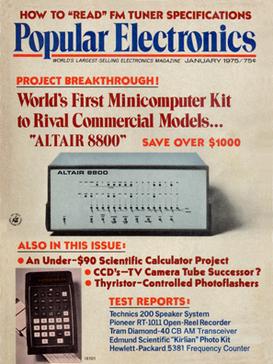
Since you know already this is the beginning of something big, several of you find work doing odd jobs and such to piece together the needed $621 to purchase one of these Altair 8800 machines (no easy feat when the minimum wage is $2.10 per hour).
Altair in hand, it's time to figure out how to use it.
Wednesday, September 2nd
Tasks
Do each of the following initial tasks:
- Create a new git repo named
csc215. -
Using your VCCS email, send me an email at
jde232@email.vccs.eduwith a link to the git repo you created in the previous step. - Read Chapter 0: Why Demystifying Computing? and complete the two exercise sets at the end of the chapter.
NOTE: I plan to design this culminating year in your computer science
pathway with an even more student-centered, problem/project based approach then
we used last year. That means that much of the responsibility for learning
falls on you to actively engage with the course, and to put in the time and
effort needed for success. I'll be responsible for defining the content and
the problems on which we will focus, framing
our study, and on working
in consultation with you to adapt and modify our specific goals and pacing as
we go, but you will need to take control of your learning process to get the
most from your experience here.
Since the best use of our time together is to work collaboratively to solve programming problems, a flipped classroom approach, where you are responsible for reading the chapters ahead of class at home, and we use classroom for collaborative problem solving. That only works if you do your homework, so I'll be responsible for helping keep you accountable. We'll discuss how in class together.
Homework
Read Part 1: Introduction from the
Altair 8800 Operator's
Manual, taking notes in your git repo in a document named
logic_and_number_system_notes.md.
Due Date and Evaluation: This assignment is due by Friday, September 4th at 11:59 pm so that I can evaluate it over the weekend, using our CSC 215 Class Git Repo Grading Rubric.
Monday, August 31st
GHC buses won't be running today, so we will have less than half the class here today. We'll use this time to start playing with the Altair 8800, but won't start class formally until we are all here on Wednesday.