OER for an Integrated CS / Web Dev Pathway
Peer Group Meeting: Open Educational Resources, Distance Learning, and Technology, February 2026
Chris Jones | Jeff Elkner
Intro / Summary
Intro / Summary
- Dual Enrolled CS / IT Classes in Arlington, VA
- Our school has a unique student body, including full- and part-time students
- We’re developing an integrated CS pathway
- Project-based learning:
- Real projects, real customers
- Collaboration with professional developers around the world
Radical Transparency
You can find everything we do on our website:
https://ict.gracehopper.center
On our homepage, a link to these slides, and an accompanying PDF that has additional notes, links, and examples.
CS @ The Grace Hopper Center
Dual Enrollment
- Our students:
- Earn normal high school credits
- Sit for industry certification tests (82 certifications so far this year, and counting!)
- Earn 7 college credits per year-long class
- Connect with resources and faculty at NOVA
- Graduate high school with an A.S. in CS
Our DE Program Has Some Unique Differences
- Cohort model - we have the same students all four years
- Mixing CS/IT Courses
- Thanks to NOVA for working with us on prerequisite requirements
- Backwards Design
- At the end of second year, students have a portfolio demonstrating full-stack web development experience
- And are prepared to continue to a four-year universty
Integrated Pathway
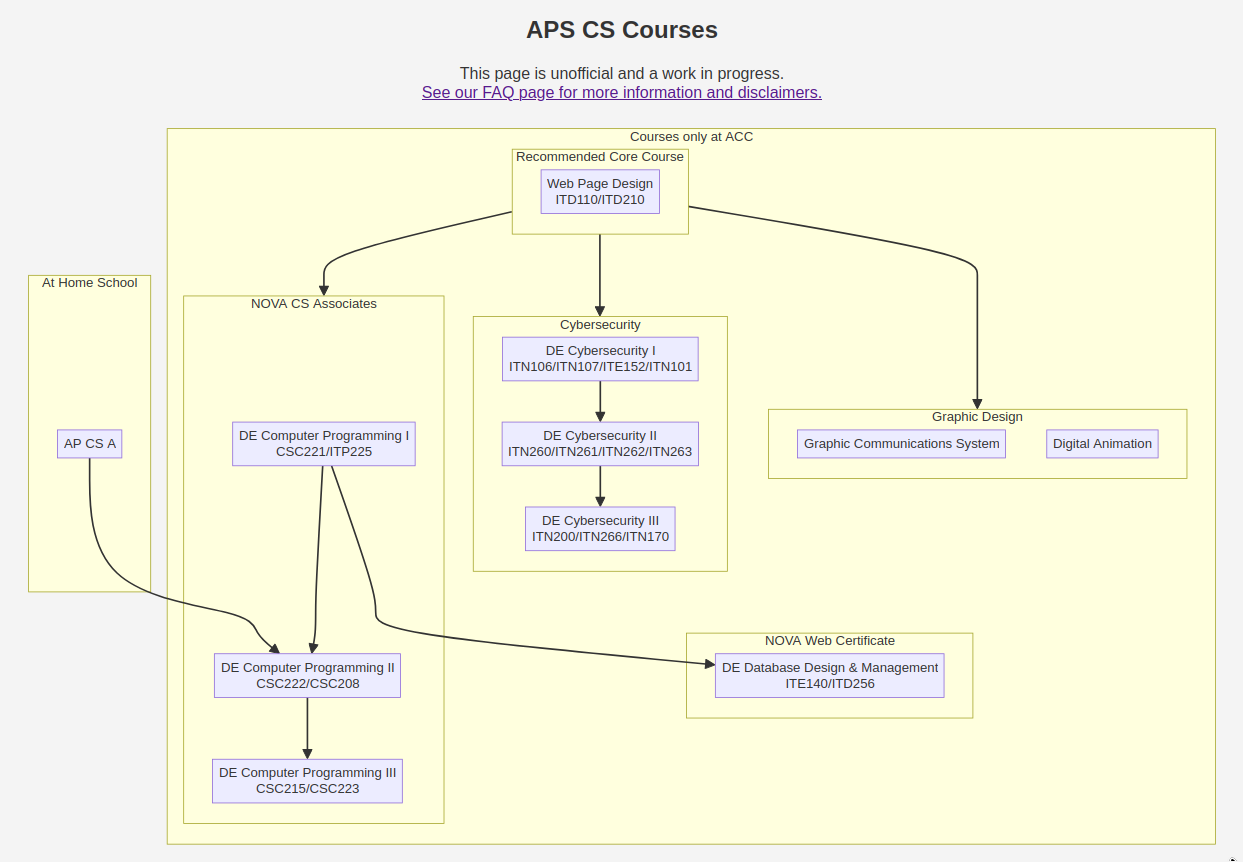
- Tightly-coupled courses
- Strict pre-requisites
- Emphasis on full-stack web development
- Online portfolio maintained throughout the pathway
Our Courses
OER @ GHC
Teaching without OER - a parable
- My first year as a CS teacher, a colleague showed me an exciting online learning / coding sandbox. Together we convinced our school system to buy expensive licenses, and I spent a ton of time building lessons and coding problems on the site
- When we shared this story with a colleague, they wrote back with
some questions:
- “When we write material, who owns it? If we end contract in 2 years (or they go belly up), do I still have all of my questions, and in a usable form?”
- “If I keep my materials on {platform}, what happens when I want to share or give to students that are not subscribed? Will my NVCC students not be able to use those materials?”
- At the end of that school year, the system was acquired and closed down. All my materials were lost :/
- Our school system moved to another big name online CS curriculum vendor and spends >$2000 per section for access
- It’s a good system, but I don’t love the way some of the lessons were presented, and had no ability to create my own exercises, re-mix materials, etc
- Occasional payment glitches leave us locked out with nothing
OER
- Everything we do is based on OER resources that we either find or create
- Class websites <ict.gracehopper.center> licensed under CC BY-SA 4.0
- Textbooks released via https://openbookproject.net/
Open Source Software
- Strong emphasis on low-level, open source software for all of our in-class exercises
- 9th graders spend a lot of time learning unix command line, git, vim.
OER - Student Contributions
- Students are part of the system!
- All of our work is contained in public git repos, students are invited to contribute
- Students select licenses for each repo they create
- Student project work becomes part of future classes
Project Based Learning (PBL)
PBL - In Theory
- We love it!
- Dogfooding - develop projects that help our own communities
- Technical and durable skills develop together
PBL - In Practice
- A few recent projects:
- Arlington 2050 Survey Data Analysis
- Nova Web Development, Jetro Web Development, Worker Co-ops
- Django Reservation Systems
Questions / Contacts
Thanks!
- Chris Jones: cmj2310@email.vccs.edu
- Jeff Elkner: jde232@email.vccs.edu
- https://ict.gracehopper.center